
Episode 5
The Role Reversal
-
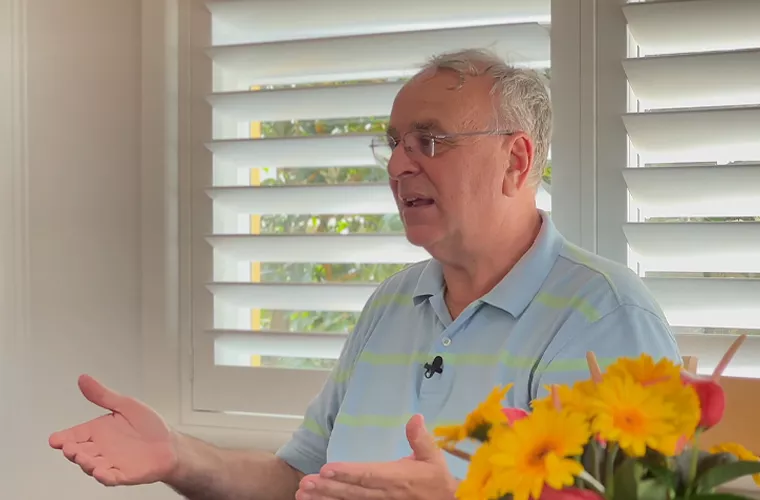
This transcript features Julie in conversation with Megan Van Genderen and Jason van Genderen from 'Everybody's Oma', sharing her experience of becoming the primary carer for her mother, Margaret. Together, they discuss caregiving responsibilities, sibling dynamics, respite care, the transition into residential aged care, and the emotional journey of rediscovering their mother-daughter relationship.
Introduction
00:00:02 | Julie:
Hi.00:00:03 | Jason van Genderen (Interviewer):
Good morning.
How are you?00:00:05 | Julie:
Good.00:00:14 | Megan van Genderen (Interviewer):
Alright. Well, Julie, thank you very much for having us in your home.00:00:18 | Julie:
That's fine. Thanks for coming.00:00:18 | Megan van Genderen (Interviewer):
To chat about your experience with your mum and placing her into a care community recently.Your mum, Margaret, is living in Quakers Hillside.
Can you tell us a little bit about Mum? What's she like as a person?
Tell us about Margaret
00:00:31 | Julie:
She's colourful. Neurotic.She was an actress in her younger days.
She just lives and loves the arts, lives for the arts.
That was probably her greatest gift that she instilled in us, a love for the arts.
Becoming her carer
00:00:47 | Jason van Genderen (Interviewer):
Were you involved in her care journey at all during that time with her?00:00:52 | Julie:
I moved her in with me here.At that stage, I didn't really have to care for her.
She was still on her feet.
Every day she'd catch the train from Blacktown Station into Wynyard, wander around the city as she always did, and go to shows at the Town Hall.
Then she had a fall and broke her hip, and that made things hard.
She had the operation and then went into rehab for three months.
They were telling me there, "Maybe you should think about putting your mum into care."
I wasn't quite ready for that, and I thought, "No, I'm pretty sure I can cope at home with her."
She got back on her feet with a frame.
Five challenging years
00:01:34 | Julie:
The last five years were very challenging.What made it harder was that I have a brother who lives in Canada, a sister in Perth, and another brother who, at that stage, was living in Gladesville.
But it all just sort of fell on me.
00:01:50 | Jason van Genderen (Interviewer):
I find it interesting because even in families we've spoken to where family members are living closer together, there always seems to be one sibling who takes the main carer role.That obviously was you.
That's a big responsibility.
00:02:05 | Julie:
It was.I had to fight not to feel resentment at times when I wouldn't get calls for months and months from siblings interstate or overseas.
I had no freedom.
I started looking into respite, but that was hard too.
I realised you couldn't just be spontaneous.
You had to book respite months in advance.
Sometimes a girlfriend would say, "Do you want to come and stay a night?"
And I'd have to say, "Well, I can't."
I'd left Mum a couple of times when she was still using a frame and independent enough to get to the toilet herself.
She'd say, "Oh no, I'll be fine."
Then I'd come home and she'd fallen over.
That was traumatising.
Reaching a turning point
00:02:46 | Jason van Genderen (Interviewer):
That's horrible, isn't it?Because as a carer you're trying to do the right thing, but you also need some autonomy yourself.
00:02:53 | Julie:
That's right.That was really hard.
00:02:58 | Megan van Genderen (Interviewer):
So the social worker put you in touch with three care communities.Did you get a chance to tour all of them?
Discovering Quakers Hillside
00:03:08 | Julie:
Actually, no, I didn't, Megan.What happened was Quakers Hillside was on the list. There were two others, but this was the closest to me.
I thought I'd start with the closest because there was another one about 10 kilometres away, but I thought this would be more convenient for visiting.
I didn't need to go any further.
I pulled up at this place and thought, "Wow, this is not what I was expecting."
It was beautiful, like a lodge.
Everyone welcomed us.
I couldn't imagine that I would find anywhere nicer.
00:03:46 | Julie:
Mum moved into a beautiful room all on her own with this big window overlooking the garden and the magnolia trees.Getting their relationship back
00:03:54 | Megan van Genderen (Interviewer):
Now that you've transitioned into visiting, how do you feel?00:04:00 | Julie:
This is a good point that we should discuss.All those years I was caring for Mum, we lost our relationship.
I felt we did, anyway, as mother and daughter.
I couldn't cuddle Mum a lot.
I found it hard to show affection.
Maybe it was inbuilt resentment. I don't know.
00:04:20 | Jason van Genderen (Interviewer):
Maybe it's a bit transactional too.00:04:22 | Julie:
I think so.Because I was a carer, and it's like I ceased to be her daughter for a while.
Now I'm going to get emotional.
In her twilight years, I'm finally...
What was torturous was thinking she's going to go, and I didn't want her to go while I still felt resentment.
But I'm so grateful we got through that.
She's been in there, and now we've got our relationship back.
So if she goes, we are back to being mum and daughter before she leaves this earth one day.
Closing thoughts
00:04:55 | Jason van Genderen (Interviewer):
Julie, thank you so much for inviting us into your home to have a chat.I'm sure your story is going to help a lot of other people as well.
00:05:01 | Julie:
And thank you both.You've both been lovely.
00:05:04 | Jason van Genderen (Interviewer):
Thank you.
Listen to the full conversation
Listen to the full conversation on our podcast. New episodes are released every two weeks.